Categories
funding updates

NEH Grant Application

We recently submitted a grant application to the National Endowment for the Humanities and wanted to share with our readers the project narrative for ZineCat. Take a look below to learn more about our evolving project, or you can check out a copy of our application that we’ve shared on Shared AuthorityVol. 2.5 here.

Introduction

The Zine Union Catalog (ZineCat) is a shared catalog dedicated to zines. A zine, short for fanzine or magazine, is a DIY publishing medium traditionally used by subculture communities for sharing their lives and knowledge. A shared catalog is a resource where libraries can mingle cataloging and holdings information. Zines are primary sources for humanities, social sciences, and other fields, but due to the diverse standards and practices among libraries, archives, and community organizations that collect and maintain them, accessing zines through traditional research discovery systems has been challenging. ZineCat empowers researchers to discover zine holdings by searching a single catalog, helps librarians copy catalog records to eliminate duplication of effort, and facilitates lending. ZineCat serves educators, researchers, librarians, archivists, zine makers, and anyone with an interest in zines. 

Index card titled "What is a Zine? [Star] My Definition:" with the definition: "For me a zine is not just a self-made and self-published booklet but it is also situated within DIY culture. This means it is non-profit, non-commercial, low-budget, and non-competitive. Topics and styles can vary but it's important that zines remain accessible, both to readers (everyone can afford to buy or trade them) and to writers (everyone can make them). Zine don't exist as little paper islands but they are connected and blossom within a mutually supportive zine community."
Scissors & Chainsaws No. 2 : Diary Comic Zine Made in July 2020 During International Zine Month. Ghent, Belgium: Nina Nijsten, 2020.

ZineCat contains three primary components:

  • Catalog records for zine titles (descriptive metadata), which give identifying (title, creator name(s), production date and location) and contextual information (subjects, genres, abstracts, biographical and historical details)
  • Holdings information (details about libraries that hold specific issues)
  • Digitized and/or digital content when available

Developed by Jenna Freedman (Barnard College) and Lauren Kehoe (NYU) in our MA Digital Humanities (MADH) program at the City University of New York Graduate Center (CUNYGC), ZineCat’s prototype combined into a Collective Access catalog3 thirty records each from three libraries with different metadata schema: MARC, Dublin Core, and an 18-column spreadsheet. The prototype has grown to include almost 34,000 zines from eight collections with more ingests in progress. 

The zine library community values cooperation and intentionality, so we need to match the prototype growth in concert with improved infrastructure and participant collaboration systems. NEH funding creates space for deliberation, care, and clarity as we unite our catalogers and contributors in person. The grant will enable us to accomplish this necessary next step.

Significance

Zines provide firsthand accounts of social, political, economic, and cultural experiences and insight that, unlike journalism and academic scholarship, are not filtered through gatekeepers or formal editorial structures. They are produced in small runs and are often distributed by the author(s). Zines facilitate knowledge production and dissemination within marginalized, racialized, and socially alternative communities that have been overlooked or excluded by cultural heritage institutions. They are used as primary sources by students, journalists, scholars, and anyone interested in material culture, print culture, and book history. Topics represented in zines, zine culture, and zine topics, include, but are not limited to: girlhood, music fandom, homophobia in high school, people of color in punk, the Michigan Womyn’s Music Festival, midwifery, the evolution of desktop publishing, self-publishing as activism, reactions to 9/11, fat activism, and pandemic life.

Even before they were called zines or fanzines, self-publications were a mechanism for people holding marginalized identities to share their experiences with people of similar or questioning identities, and others. The 1926 Fire!! Devoted to Younger Negro Artists by Wallace Thurman, et al. and Vice Versa, launched by Lisa Ben (an anagram for lesbian) in 1947, are forerunners. Zine movements have been accurately characterized as heavily populated by white people,  despite the contributions of Black, Indigenous, and People of Color (BIPOC) creators throughout zine history, but in recent years zine culture has become significantly more representative. For example, the NYC Feminist Zinefest, held at Barnard College annually since 2014 (on hold due to Covid), has had a steady grown in BIPOC tabler presence each year. In 2020, more than 50 percent of the tables were to be staffed by individuals and groups of color. 

Perhaps because zines exist in counter cultural spaces, they were first collected and circulated by independent zine libraries. By the early 21st century, public libraries, special collections, and academic library workers began collecting zines as research resources and as part of leisure reading collections. This hybrid environment of zine collections translates to dispersed and varied mechanisms for access. Zine descriptions and metadata, and thus discovery of zines, are strewn across library catalogs, archival finding aids, standalone databases, spreadsheets, print handouts, and proprietary online platforms. This multiplicity poses impediments to finding and using zines in aggregate for research, teaching, and learning. ZineCat saves a reader’s time by collocating metadata from these disparate sources.

Zine librarians field personal and research questions from people looking to find themselves represented on library shelves, to discover others who share cultural shorthands, or who have experienced the same joys and torments. ZineCat will host holdings from any and all collections that wish to participate and will become an essential resource for answering lay and scholarly inquiries. 

By harmonizing metadata rather than standardizing it, ZineCat allows the zine community to preserve its diversity and leave control over represented words, images, and ideas to the original makers, a hallmark of zine culture.” Control over one’s words, images, and ideas is a hallmark of zine culture. For example, in the appendix, we have included a table of descriptors of one zine held at six different libraries. Each record for Doris by Cindy Ovenrack Crabb is notably different from the others. Some contain narratives in addition to basic metadata. The metadata do not always agree, even with regard to the author’s name. Doris, a serial with several distinctly titled issues, is variously cataloged as a serial and a monograph. For a zine like Doris, ZineCat will serve as a hub for information, connecting but not necessarily overlaying serial, monograph, and finding aid records.
Categories
miscellaneous zine librarians

Zine Subject Thesaurus

Last week we discussed the Homosaurus, so we thought we should also feature the similarly important work being done by Anchor Archive! For those who don’t know, Anchor Archive uses its own customized thesaurus of subject terms (or keywords) to describe zines in their collection. They developed it between 2008 through 2013 because they wanted to use subject terms that were more accessible, current, and radical than standard subject headings, like the Library of Congress Subject Headings. This Zine Subject Thesaurus is used by other zine libraries and zine collections around the world, including at ZineCat!

Black and white logo of Anchor Archive Zine Library which features a typewriter on an anchor in the center, framed by hand-drawn stars.

You can find the full Zine Subject Thesaurus here. The Anchor Archive is currently updating its thesaurus in collaboration with other zine librarians. Please do get in touch if you would like to get involved. Email them at anchorarchive AT gmail.com and follow them on Instagram @anchor_archive.

Categories
miscellaneous zine librarians

Support the Homosaurus

A dinosaur stands in front of a rainbow with "Homosaurus" written in bright pink below it.

Last month at the Zines + Libraries Conference, we learned about the incredible work of The Homosaurus. The Homosaurus is an international linked data vocabulary of LGBTQ terms that supports improved access to LGBTQ resources within cultural institutions. Designed to serve as a companion to broad subject term vocabularies, the Homosaurus is a robust and cutting-edge vocabulary of LGBTQ-specific terminology that enhances the discoverability of LGBTQ resources. 

This vocabulary is intended to function as a companion to broad subject term vocabularies, such as the Library of Congress Subject Headings. Libraries, archives, museums, and other institutions are encouraged to use the Homosaurus to support LGBTQ research.

To support the project, purchase a shirt from their online shop! T-shirts are currently on sale for $15 until tomorrow (8/10) at 5pm CT.

White t-shirt featuring the Homosaurus logo of a dinosaur in front of a rainbow.
This t-shirt could be yours! Purchase at their online store. All sale proceeds are used to support the project or are donated to LGBTQ+ organizations.
Categories
miscellaneous zine librarians

Last Day of #IZM – HalloZine!

To wrap up International Zine Month, we are remembering zinesters that are no longer with us. This HalloZine, we are we thinking of Jude Vachon. Vachon was a librarian who started the zine library at the Carnegie Library of Pittsburgh in 2008. One of her most widely known projects was a resource she created called Be Well! Pittsburgh. It began as a zine and later became a website, offering detailed lists of Pittsburgh-area healthcare practitioners and clinics available to the poor, the uninsured, and the underinsured. Jude Vachon also co-organized the Feminist Zine Fest Pittsburg with Jayla Patton and Anne Schwann. The reverberations of her work continue to impact the greater zine community.

Photograph of Jayla Patton, Anne Schwann and Jude Vachon
Feminist Zine Fest Pittsburgh organizers Jayla Patton, Anne Schwann and Jude Vachon
Image Credit: Pittsburgh City Paper

Take this HalloZine to revisit Jude’s contribution to Learning to Love You More:

Assignment #40
Heal yourself.

“Cure for Depression”
Jude Vachon
Pittsburgh, Pennsylvania USA

Go and watch some birds. But allow yourself to be intimate about it, and to participate in it yourself. Do not to be an observer with a field guide.
Crows are very, very smart. So smart they’ll make you laugh out loud. Feed them several round cookies and watch how they stack them before they make off with them. If you invest yourself they will usually be up for a personal relationship with you, over time.
If you’re in the Mid-Atlantic region, watch the huge throngs of starlings gathering and playing all over the skies together and having conferences in trees before they head south for the winter. They are really very good at being loud together.
Blue Jays are huge bitches. They are mean and nasty and scream. Enjoy that.
There’s much more.
Do whatever is necessary to make room for this. I do mean whatever is necessary. It’s serious.

About Learning to Love You More

Learning to Love You More is both a web site and series of non-web presentations comprised of work made by the general public in response to assignments given by artists Miranda July and Harrell Fletcher. Yuri Ono designed and managed the web site.
  

Categories
miscellaneous zine librarians

#IZM – Post online about your favorite zines!

For July 28th, we are talking about our favorite zines.

Queering Friendships Zine by Mixed Rice Zines

This zine is a charming riso-printed booklet dedicated to exploring love and intimacy between queer friends and platonic lovers. It features submissions from queer, trans, and non-binary artists of colors. Broken Pencil also selected this zine for Group Zine of the Year in 2021.

Image of a green zine, with hand-drawn images of letters and photographs with the text "Queering Friendships Zine"
Image Credit: Mixed Rice Zines

About Mixed Rice Zines

Mixed Rice Zine is a small DIY press run by artist J Wu, featuring a mixture of voices that celebrate QTBIPOC resilience. Their zines invite queer and trans artists of color to send in writing, photography, comics, poetry, interviews, illustration and more.

Riot Grrrl Zines

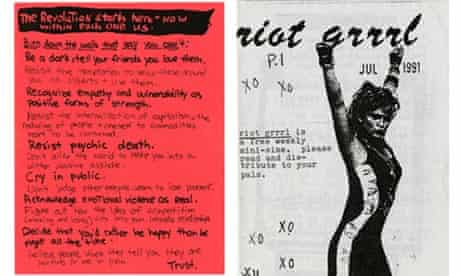
Every discussion of zines will inevitably intersect with Riot Grrrl, a punk feminist movement that emerged in the late 1980s and early ’90s in reaction to pervasive sexism, racism, and homophobia in the punk music scene and in the culture at large. Emphasizing female and youth empowerment, collaborative organization, creative resistance, and DIY ethics, the Riot Grrrl movement generated hundreds of self-published zines. A sampling of zines, posters, and printed matter from the 1980s and ’90s can be found in this fabulous book, edited by Lisa Darms and published in 2013.

A flyer by Kathleen Hanna of the band Bikini Kill sets out her manifesto for change; and the first issue of the zine Riot Grrrl, by Molly Neuman and Allison Wolfe, July 1991. Image Credit: The Feminist Press

About the Editor

Lisa Darms is Senior Archivist at the Fales Library & Special Collections at NYU, and founder of the Fales Riot Grrrl Collection. She holds an MA in History and Archival Management from NYU, an MFA in Photography from the University of Washington, and a BA from the Evergreen State College. Her writing has been published in The Believer, Women & Performance Journal, and Archivaria. Before coming to archives she taught photography, worked as a custom photo printer, and was a member of the collaborative art group Thin Ice. Darms grew up in British Columbia, Canada.

Categories
miscellaneous zine librarians

Highlighting Queer Zine Library for Zine Library Day

July 21st is Zine Library Day! To celebrate, we wanted to highlight the Queer Zine Library. The Queer Zine Library is a UK-based DIY mobile library with an emphasis on radical LGBTQIA+ self-publishing.

Inspired by the Hong Kong-based Queer Reads Library, Queer Zine Library collection was officially formed in June 2019 with the first iteration of the Queer Zine Library taking place at Gunnersbury LGBT Late event in 2019. Since then, it has travelled across the UK in pop-ups and residencies.

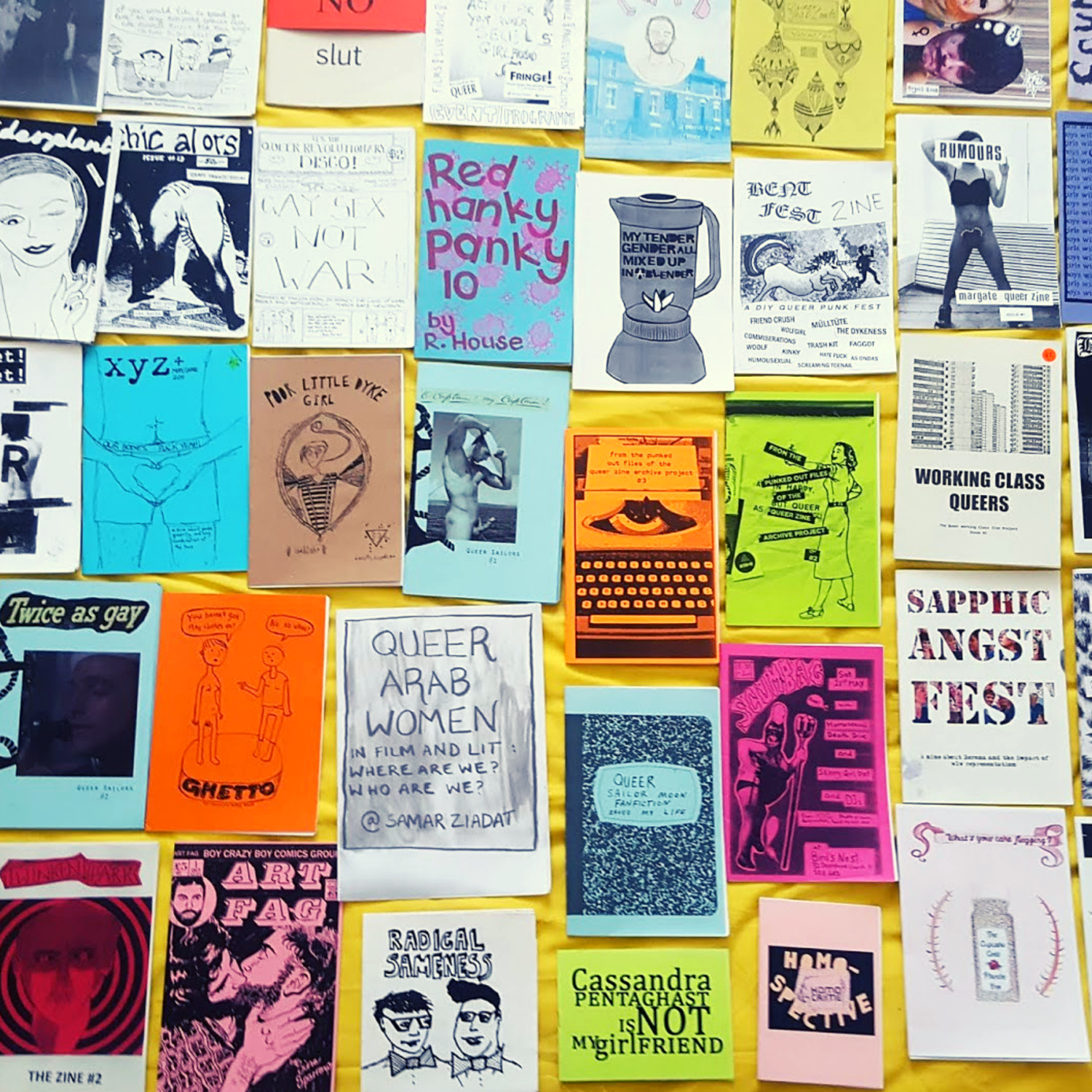
Queer Zine Library is led by a collective of volunteers who catalogue, fundraise, host workshops, and develop the collections. The library includes 800+ zines and self-published material. The majority of these zines are published in the UK, Europe, and USA  from 1980s to present day. These zines include perzines, fanzines, chapbooks, community newsletters and small press comics. They span themes of activism, queer punk, fandom, sex, relationships, mental health, LGBT spaces and nightlife.

Follow them on Instagram and be sure to check out their incredible digital catalogue. Currently, about a 1/4th of their collection is catalogued.

An image of a couple dozen colorful zines laid out on a yellow cloth. Some titles include "Queer Arab Women" and "Poor Little Dyke Girl."
A sampling of some of the zines in the Queer Zine Library. Image Credit: Queer Zine Library

P.S. This is still a relatively new development, but ZineCat and the Queer Zine Library have been in conversation to add their collection into our database in the near future once we streamline our ingest process. We are very excited!

Categories
miscellaneous

Zine Distro Appreciation Day

July 19th is Zine Distro Appreciation Day according to this awesome poster Alex Wrekk of the Stolen Sharpie Revolution made. [For more details, see post from a couple weeks ago!]

For the occasion, we are highlighting a few zine distros. Zine Distros distribute zines! They are usually small operations that will sell zines either in person or online. Here are a few zine distros to follow and support:

Brown Recluse Zine Distro – Oakland, CA

Brown Recluse is a volunteer-run, not-for-profit zine distro for and by queer and trans, black, indigenous and people of color. They were established in 2013 as a direct response to the lack of support in the zine community for non-white creators. Brown Recluse exists to strengthen our ties and highlight our intersectional, relatable experiences.

Portland Button Works – Portland, OR

Portland Button Works is a distro and shop that is deeply rooted in a DIY and punk ethos. They focus on zines that reveal how the personal is political. The shop also carries buttons and books on witchcraft, paganism, and the occult.

Bluestockings Cooperative – New York, NY

Bluestockings Cooperative is a worker-owned community space and bookstore guided by the principles of abolition, feminism, solidarity, and transformative justice practices. They carry zines from new and established authors, and those on abolition and political education, disability justice, DIY and how-to, perzines (memoir), and other educational and creative non-fiction titles.

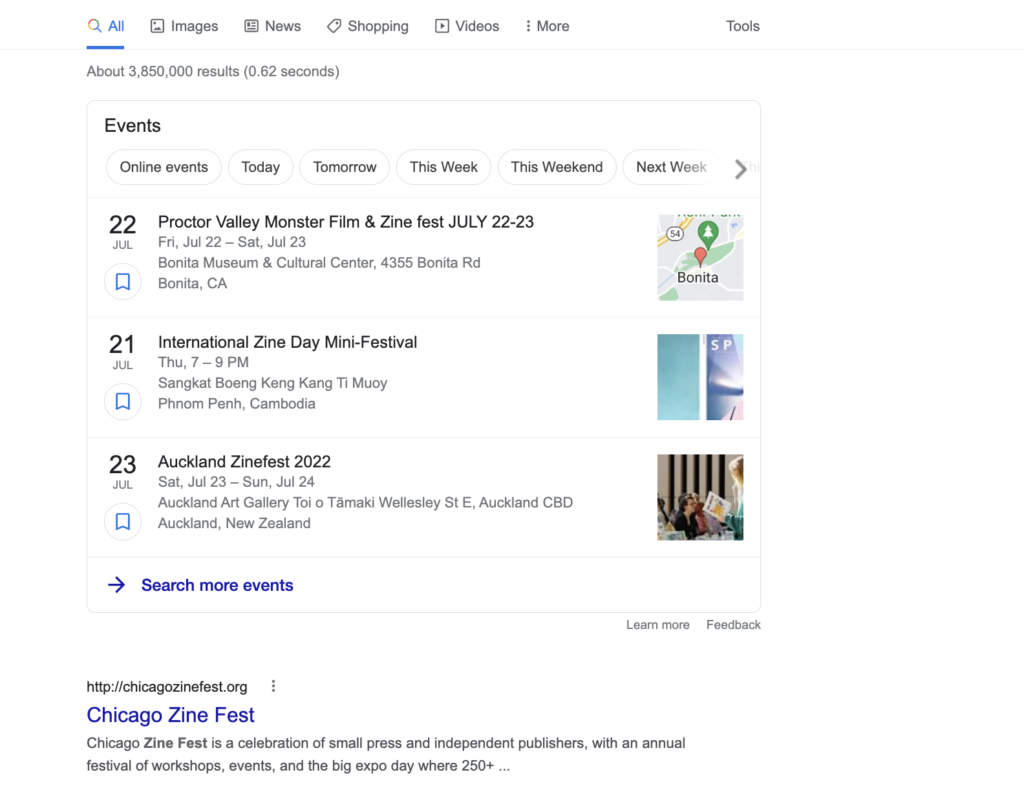
You might also discover new zines and support zine distros by checking out your local zine fests. I was astonished to find a quick online search “zine fest” yielded a ton of upcoming zine festivals from Bonita, CA to ones in Cambodia and New Zealand. Chances are there will be zine fests around you too!

Screen capture of a Google search for "zine fest."
A quick Google search of “zine fest” pulled up a ton of results!

What are some of your favorite zine distros? We would love to hear about them in the comments.

Categories
conference presentations zine librarians

Highlights from the Zines & Libraries Conference

Last Friday July 8th, our project co-manager Jenna Freedman spoke about issues in zine cataloging. Informed by her experience as the zine librarian at Barnard College, Freedman talked about how to use resources like subject headings, genre and format terms, summaries, and MARC to make rich records. The discussion was also informed by critical thinking about racial, ethnic, gender, and other creator identities. Though metadata may seem sometimes innocuous, Jenna importantly stressed that cataloging is political.

Check out the Issues in Zine Cataloging guide Jenna created for the discussion. Many thanks to Jenna for facilitating this thoughtful conversation and producing this informative guide!

A cartoon drawing of a zine librarian looking at a text bubble with the words: "Shared Zine Metadata," which has twinkles and and a heart next to it. Above the drawing is the subject heading:" xZINECOREX: an Introduction."
Freedman also touched upon xZINECOREx and MARC and their semi-equivalencies.

About Jenna

Jenna Freedman (she/her) is the Curator of the Barnard Zine Library at Barnard College in New York City. She makes an annual zine called Lower East Side Librarian and one-off zines on topics including jury duty, menstruation and menopause, and niche cataloging discussions on the library email list AUTOCAT.

Categories
miscellaneous zine librarians

Celebrating International Zine Month

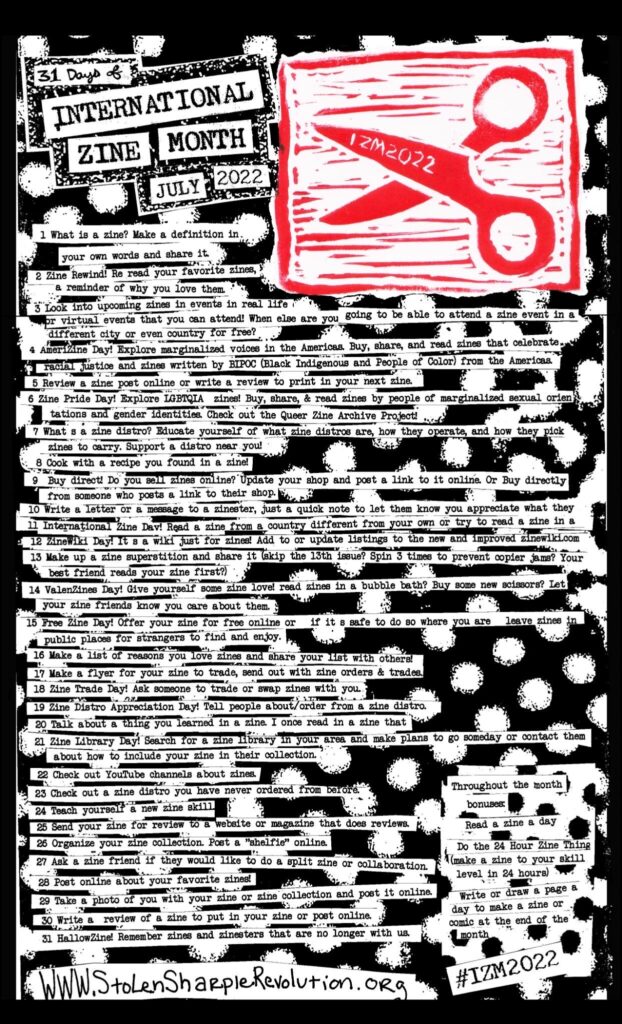
A black and white poster with a pair of red scissors printed on the top right hand corner. The poster suggests 31 prompts for each day of International Zine Month.
Image Credit: Alex Wrekk

July is International Zine Month! Alex Wrekk of the Stolen Sharpie Revolution put together this awesome poster with prompts for each day of the month. The text from the poster is shared below:

31 Days of International Zine Month 2022 #IZM2022

1 – What is a zine? Make a definition in your own words and share it.

2 – Zine Rewind! Re-read your favorite zines and remind yourself why you love them.

3 – Look into upcoming zine events to attend in real life or virtual events that you can attend! When else are you going to be able to attend a zine event in a different city or even country for free?

4 – AmeriZine Day! Explore marginalized voices in the Americas. Buy, share, and read zines about racial justice and zines written by BIPOC (Black Indigenous and People of Color) from the Americas. Need a place to start? Check out Brown Recluse Zine Distro. 

5 – Review a zine: post it online or write a review to print in your next zine.

6 – Zine Pride Day! Explore LGBTQIA+ zines! Buy, share, and read zines by people of marginalized sexual orientations and gender identities. Check out the Queer Zine Archive Project! 

7 – What’s a zine distro? Educate yourself of what zine distros are, how they operate, and how they pick zines to carry. Support a distro near you!

8 – Cook with a recipe you found in a zine!

9  – Buy direct! Do you sell your zines online? Update your shop and post a link to it online so people can get your zines directly from you. Or buy directly from someone who posts a link to their shop.

10 – Write a letter or send a message to a zine maker, just a wuick note to let them know you appreciate what they do.

11 – International Zine Day! Buy, share, or read zines from a country different than your own.

12 – ZineWiki Day! It’s a wiki just for zines! Add to or update listings to the new and improved zinewiki.com

13 – Make up a zine superstition and share it (skip the 13th issue? Spin 3 times to prevent copier jams or avoid paper cuts? Your best friend has to read your zine before anyone else?)

14 – ValenZines Day! Give yourself some zine love in whatever way it means to you! read zines in a bubble bath? Buy some new scissors? Let your zine friends know you care about them.

15 – Free Zine Day! Offer your zine for free online or – if it’s safe to do so where you are – leave zines in public places for strangers to find and enjoy.

16 – Make a list of reasons you love zines and share your list with others!

17 – Make a flyer for your zine to trade with others, post online, or send out with zine orders and trades.

18 – Zine Trade Day! Ask someone to trade or swap zines with you.

19 – Zine Distro Appreciation Day! Tell people about your favorite zine distros! Order zines from a distro.

20 – Talk about something you learned in a zine. Start with “I once read in a zine that…”

21 – Zine Library Day! Search for a zine library in your area and make plans to go someday or contact them about how to include your zine in their collection.

22 – Check out YouTube channels about zines. Here are some to visit:

23 – Check out a zine distro you have never ordered from before.

24 – Teach yourself a new zine skill (like a new binding technique or how to make a 1 page zine).

25 –  Send your zine out for review to a website or magazine that does reviews.

26 – Organize your zine collection. Post a “shelfie” online.

27 – Ask a zine friend if they would like to do a split zine or collaboration with you.

28 – Post online about your favorite zines!

29 – Take a photo of you with your zine or zine collection and post it online.

30 – Write a review of a zine to put in your zine or post online.

31 – HallowZine! Remember zines and zinesters that are no longer with us.

Throughout the month bonuses :

  • Do the 24 Hour Zine Thing (make a zine to your skill level in 24 hours)
  • Read a zine a day.
  • Write or draw a page a day to make a zine or comic at the end of the month.
  • Write a letter or online post about your #IZM2022 experience.
Categories
conference presentations updates zine librarians

Summer Updates

It’s been a busy few weeks with the ALA (American Library Association) Conference and Zine Pavilion last month. At the conference, Lauren gave a presentation on the Zine Union Catalog and garnered a lot of interest in the project as well as questions around metadata. For this occasion, we also produced new issue of Shared Authority. Volume 2.5 (along with all our previous issues) can be found on our public Google Drive.

This summer, we are also prioritizing accessibility. ZineCat is currently doing a web audit with HaiDev (with many thanks to Eric, who is project managing this) with the goal of making improvements to our site. We have also been producing other formats for our zines (audible and plain text), which can also be accessed on the public Google Drive. All three issues of Shared Authority are available as scanned pdfs, as well as in audible and plain text files.

If you have any other suggestions on improvements we can implement to make ZineCat more accessible to all, please let us know. Feel free to send us an email at zinecatproject AT gmail.com. We always appreciate your feedback.

The back and cover of Shared Authority v. 2.5, which features the ZineCat paw logo on the cover and an photo of an orange cat lounging next to a previous issue of Shared Authority on the back. Inscribed are also the names of the ZineCat Team: Lauren Kehoe, Jenna Freedman, Eric Goldhagen Freedman, Vita Kurland, and Jennifer Chen-su Huang.
Back/Cover of the lasted issue, Shared Authority v. 2.5

css.php