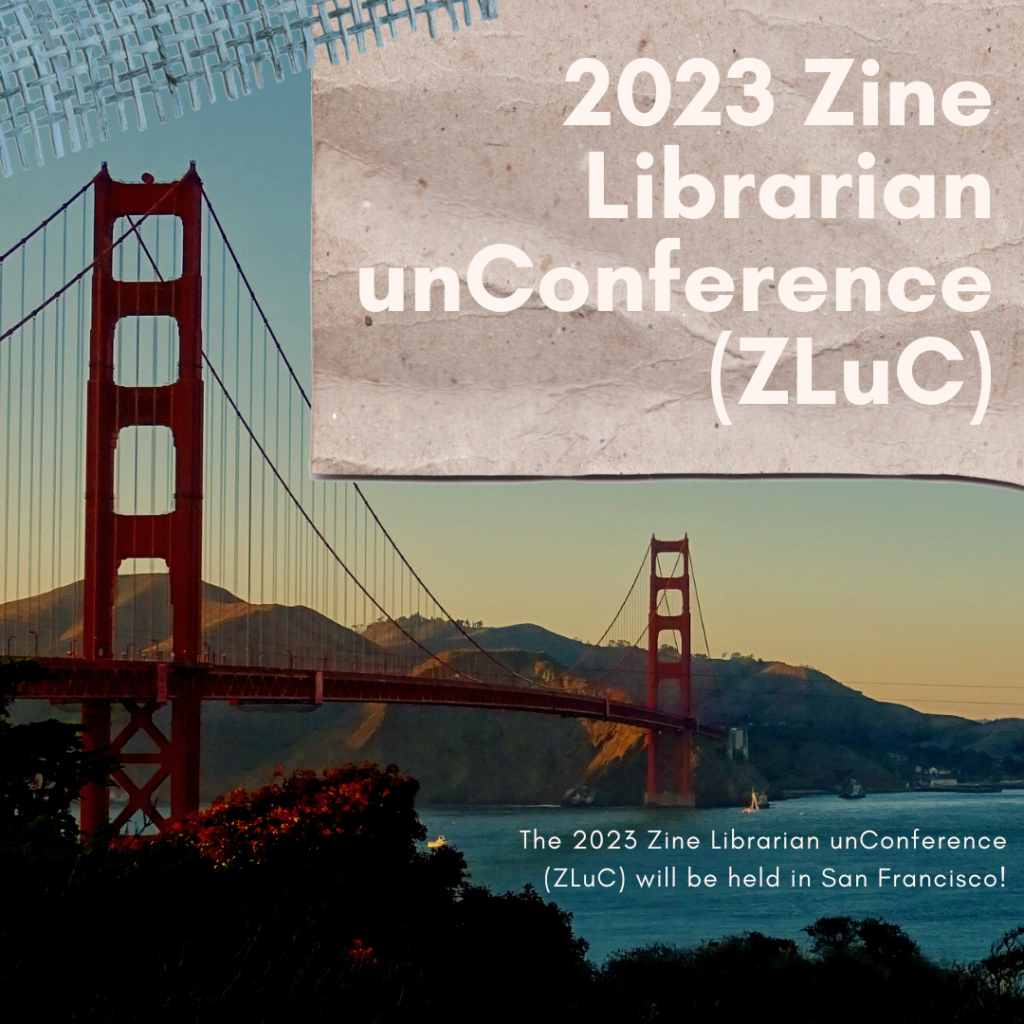
Hope your new year has been off to a great start! We have an exciting announcement to share: the 2023 Zine Librarian unConference (ZLuC) will be held in San Francisco! For those who don’t know about ZLuC –
What: ZLuC is an inspirational, informative, and fun gathering of people who care deeply about zines and their ability to change lives for the better.
Where: the University of San Francisco (and hopefully other venues!)
Who: Everyone is welcome! The primary audience is workers and volunteers from academic, public, and special libraries, as well as community-oriented independent libraries and archives. If you’re interested in zines in libraries and archives, we’re happy to have you join in the fun.
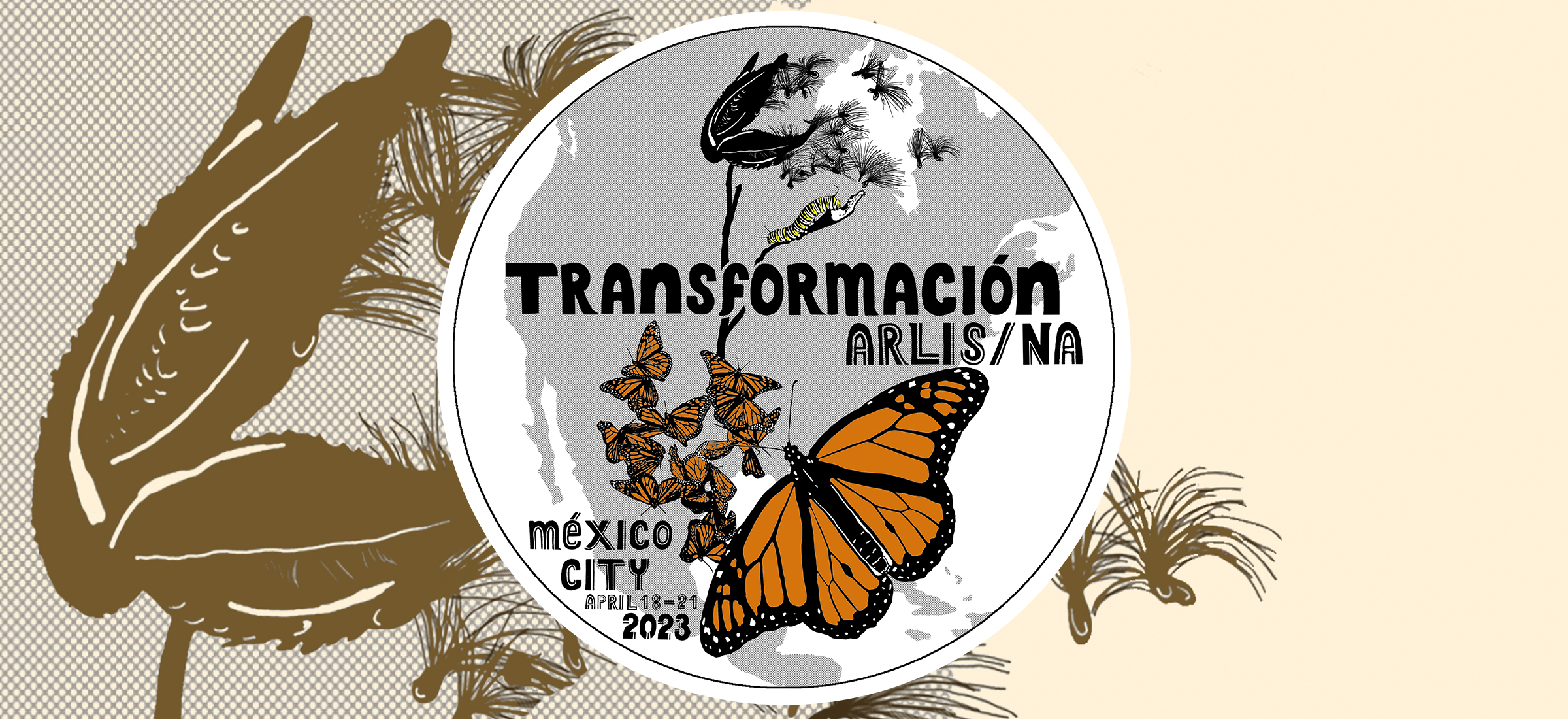
We are excited to announce that ZineCat Project Manager Lauren Kehoe and Anchor Archive Librarian Amanda Stevens will be presenting at the ARLIS/NA Conference on ZineCat and Zine Thesaurus this spring. Read more about their session below.
Image Credit: Art Libraries Society of North America
Community Tools for Radical Collections: Building a Subject Thesaurus and Union Catalog for Zines
Zines are rich research materials, increasingly being collected across libraries. Perhaps because zines exist in counter-cultural spaces, they were first collected and circulated by independent zine libraries. This hybrid environment of zine collections translates to dispersed and varied mechanisms for access and description. Descriptions and metadata, and thus discovery of zines, are strewn across library catalogs, archival finding aids, standalone databases, spreadsheets, print handouts, and proprietary online platforms. This multiplicity poses impediments to finding and using zines in aggregate. Furthermore, zines are radical publications that defy rules, often lacking metadata and not fitting into standardized systems for cataloging and classification.
Members of the zine library community have been working collaboratively to build their own shared tools for improving management of, and access to, zines and zine collections. These tools include ZineCat, a union catalog for zines, and a zine subject thesaurus for alternative description. This presentation will provide an overview of both projects, how they have worked alongside each other and will continue to grow together, and how attendees can contribute to and participate in them.
ZineCat is a centralized database of zine catalog records, and a searchable database of holdings information, that will provide digital content when available. It will save a researcher’s time by collocating metadata from many disparate sources and will allow under-resourced zine libraries to copy and share catalog records.
The Zine Thesaurus is a hierarchical thesaurus of subject terms that are more accessible, current, and radical than standard subject thesauri such as Library of Congress Subject Headings. It is used in zine library catalogs and collections around the world and will be integrated into ZineCat. It was developed by an independent zine library in Canada and is updated and maintained by a dispersed group of zine librarians, with mechanisms for broad community feedback on choice of terms and contributions of new terms.
Centering on the ZineCat and thesaurus examples, we will provide an overview of the projects, how they were developed, where they’re headed, and how they use open source platforms to aggregate open data. We will discuss challenges in sustaining collaborative, international projects, independent of institutional support and how we grapple with the problems inherent in sharing information online (i.e. with respect to zine author anonymity, etc.).
ZineCat and the thesaurus are creator-centric projects because many members of the zine libraries community are zine makers, as well as zine custodians, though the catalog serves researchers and pleasure readers, as well as zine makers. This presentation will end with a call to welcome new contributors and contributions, as the projects are still in active development!
Last Friday July 8th, our project co-manager Jenna Freedman spoke about issues in zine cataloging. Informed by her experience as the zine librarian at Barnard College, Freedman talked about how to use resources like subject headings, genre and format terms, summaries, and MARC to make rich records. The discussion was also informed by critical thinking about racial, ethnic, gender, and other creator identities. Though metadata may seem sometimes innocuous, Jenna importantly stressed that cataloging is political.
Check out the Issues in Zine Cataloging guide Jenna created for the discussion. Many thanks to Jenna for facilitating this thoughtful conversation and producing this informative guide!
Freedman also touched upon xZINECOREx and MARC and their semi-equivalencies.
About Jenna
Jenna Freedman (she/her) is the Curator of the Barnard Zine Library at Barnard College in New York City. She makes an annual zine called Lower East Side Librarian and one-off zines on topics including jury duty, menstruation and menopause, and niche cataloging discussions on the library email list AUTOCAT.
It’s been a busy few weeks with the ALA (American Library Association) Conference and Zine Pavilion last month. At the conference, Lauren gave a presentation on the Zine Union Catalog and garnered a lot of interest in the project as well as questions around metadata. For this occasion, we also produced new issue of Shared Authority. Volume 2.5 (along with all our previous issues) can be found on our public Google Drive.
This summer, we are also prioritizing accessibility. ZineCat is currently doing a web audit with HaiDev (with many thanks to Eric, who is project managing this) with the goal of making improvements to our site. We have also been producing other formats for our zines (audible and plain text), which can also be accessed on the public Google Drive. All three issues of Shared Authority are available as scanned pdfs, as well as in audible and plain text files.
If you have any other suggestions on improvements we can implement to make ZineCat more accessible to all, please let us know. Feel free to send us an email at zinecatproject AT gmail.com. We always appreciate your feedback.
Back/Cover of the lasted issue, Shared Authority v. 2.5
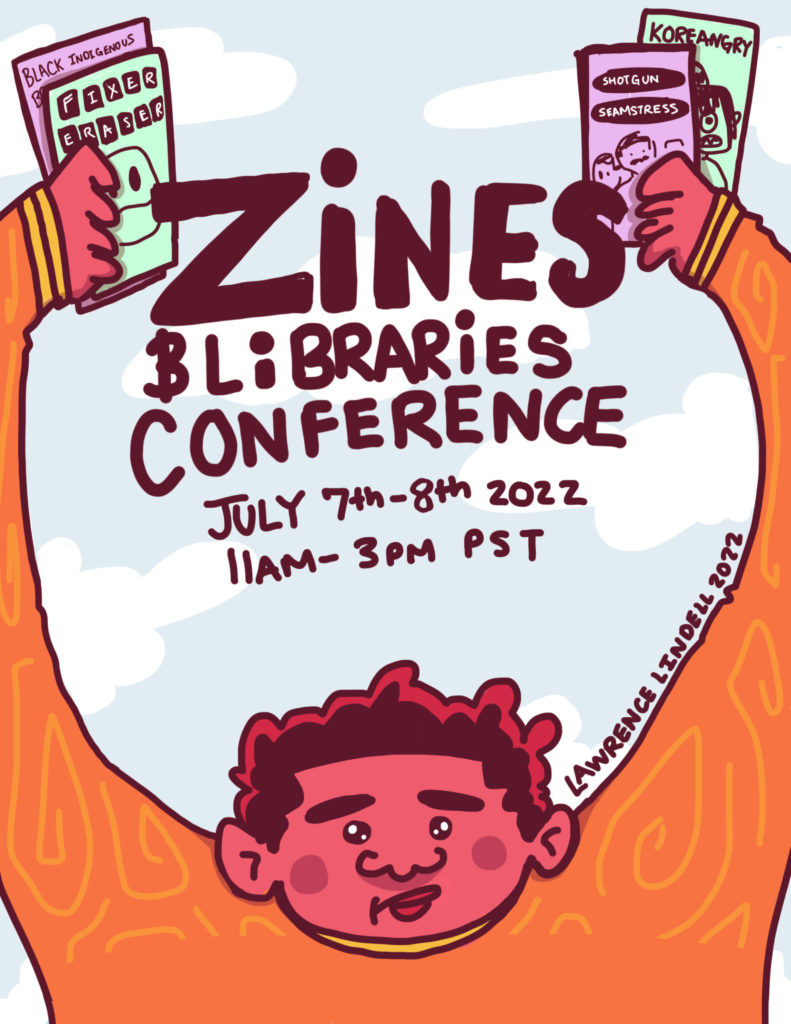
Happy International Zine Month! Join us for the 2022 Zines & Libraries Conference that starts tomorrow. Our very own Jenna Freedman will be speaking on Friday at 11am PST.
What: The Zines & Libraries Conference is a two-day virtual conference that will gather together librarians, zine artists and educators to learn about all things zines! Presenters will go over zine history, cataloging, starting a collection as well as provide tools, resources and tips on how to successfully integrate zines into libraries and instruction.
Who: Anyone interested in zines, libraries, zine librarianship and organizing zine events!
Where: This is a virtual conference, with nine separate virtual sessions, each 50 minutes long. All sessions will be hosted virtually through Zoom. Closed captioning will be provided. Please register down below.
When: July 7th-8th, 2022 (Thursday and Friday), 11am-3pm PST
This conference is made possible through the John F. Helmer Professional Development Grant through the Orbis Cascade Alliance consortium and organized by librarians Maria Cunningham (Oregon Health and Science University) and Ann “A’misa” Matsushima Chiu (Reed College).
Please email questions about registration or accommodations to Elizabeth Duell eduell@orbiscascade.org
This session, held in the Zine Pavilion (booth 2947) on Sunday, June 23 from 12-1pm, is about ZineCat (work-in-progress), a union catalog dedicated to zines! It brings together holdings from disparate libraries with divergent metadata schema. The zine union catalog attempts to harmonize, rather than normalize and find mutuality, rather than control of creators and descriptors. The catalog is built on the open access platform Collective Access and is made with zine creators in mind, as much as catalogers and researchers. We’re still just at the prototype stage and embrace new contributors and contributions!
Here’s the presentation as a slideshow and as a pdf.