Categories
planning meetings

ZineCat Planning Meeting 2024

Lauren and Jenna, along with our transcendent meeting facilitator Sara Yukimoto-Saltman, are planning the NEH Chairs Award-funded ZineCat Planning Meeting to take place at Barnard College on August 5th & 6th, 2024. The in-progress goals for the meeting are:

  1. Review, revise, and potentially pass a team structure proposal for ZineCat.
  2. Collectively brainstorm Caticorn Glaring and Fast Horse Committee work for the next 12-18 months.
  3. Choose into ZineCat roles based on our own unique gifts and talents.
  4. Brainstorm goals and a timeline for each committee for the next 12-18 months.
  5. Build trusting, joyful relationships with one another!

Participants are drawn from three countries and from a variety of zine libraries and archives including academic, community, and public. Two attendees also serve in the Zine Thesaurus Collective, as the two projects are aligned and friendly.

Zinecats, Convene!

With our fan-cat-stic and transcendent facilitator, Sara Yukimoto-Saltman, we’ve drafted an agenda to guide our work over the two days we’re together.  More details will be shared during our opening session, but here’s the…

Outline:

Sunday, August 4 (optional)

5:30 Barnard Library Tour

Monday, August 5

10:30am – 11:00pm: Welcome and Opening 

11:00-11:45am: Tributaries Activity 

11:45-11:50am: Break

11:50-12:25pm: All about ZineCat!

12:25-12:55pm: Team Structure Proposal 

12:55-1:00pm: Preview Lunch Options 

1:00pm – 2:00pm: Lunch 

2:00pm – 3:00pm: Proposal Editing

3:00-4:00pm: No Bad Ideas Brainstorm 

4:00pm-4:15pm: Break

4:15-5:15pm: Committee work for next year

5:15-5:30pm: Closing 

6 facilitated hours on Monday

Tuesday, August 6 

10:30am – 11:15am: Welcome and Opening

11:15am-12:00pm: Unique Gifts and Talents and Peer Coaching

12:00-12:15pm: Break

12:15-12:55pm: Roles Sign Up

12:55-1:00pm: Preview Lunch Options

1:00pm – 2:00pm: Lunch 

2:00pm – 3:00pm: Goal Setting and Shareback

3:00pm-3:15pm: Break

3:15pm-4:00pm: Closing

4.5 facilitated hours on Tuesday

What to expect after the convening:

We’d really like to get a strong foundation of commitment to carry this work forward over the next 6-12 months, so we are hoping that all participants will consider committing some time and labor to this next phase of organizing the project.  We have a few “tiers” of “cat-mittment” that we are hoping for:

  • High tier – co-chair of a “caticorn glaring committee” and serve on “cat herders” core group
  • Mid tier – co-chair of a “caticorn glaring” committee (aka working group)
  • Low tier – one “caticorn glaring” committee or participate on the advisory board or on a future ad-hoc committee convened by the cat herders and/or caticorn glaring working groups

Communications post convening:

  • If you can’t cat-mitt to anything after the convening, we totally understand, but we’ll still keep you informed through regular email communications and updates to the ZineCat Blog.  
  • If you do cat-mitt to a working group and/or the core group and/or the Advisory Board, we will be communicating via email and blog, but we’ll also be regularly convening as a group virtually and expecting to be co-working in documentation and other areas of development for the project.  Lauren and Jenna will work with Sara to coordinate the post-convening facilitation more strategically!

Get to know ZineCat some more:

To prepare for the convening, we’ve put together some highly recommended reading to (re)familiarize yourself with the project.  We’re not going to say required, but we really do hope you have a chance to review these materials!  We also highly encourage you to do this while curled up with your cat or favorite furry creature of choice!

Covid Precautions

We realized recently that we haven’t shared any details about the Covid precautions we’re planning for.  We’re taking our cat-cues from ZLuC but here are a few more specifics:

  • Masking is strongly encouraged.  Cat themed masks are even more encouraged!
  • If possible, please test each day (we’re working on getting tests, but if you have your own, please use them). 
  • If someone tests positive, or is feeling like they’ve contracted Covid – let us know, then we will switch to a remote convening.  Laptops/workstations will be available in the Barnard Library, but bring your own–not a tablet–device if possible!

Even More Information

We need some info from you, too!

We have a few points of information we want to get from you, so we would love for you to fill out (yes, another one) form to share this information with us.  We appreciate you doing this so much!  Like really, really appreciate it!!

Getting around NYC and Barnard

There are a few more getting around / getting to know Barnard details we wanted to share too.  A lot of info was also shared in the slide deck from our July 3 email.

  • Transportation
    • Taxis to/from airports – ask for requests and cost estimates
    • Subway details (to get between NYU and Barnard) Take the 2 or 3 (express) or the 1 train but MUST SWITCH TO 1 AT 96TH to avoid a LOOOONG and hillllly walk from 116th and Manhattan Ave.
    • Bus? Does anyone need mobility-friendly directions? Let us know!
    • Additional details about getting to Barnard in slides
  • Building access logistics
    • How to get into dorms (see slide 9)
      • If you are attending ZLuC, Jenna and Lauren will have your keys!  We can give them to you before you depart for uptown.
      • If you’re not attending ZLuC, you will check in with a housing rep from Barnard.  {More details to be added to this post as soon as we have them}.
    • How to get into library – the address is: The Milstein Center, 3009, Broadway, New York, NY 10027 

We think you’re all fabulous for taking the time to read all this!  Let us know what questions you have!!  

xxoo Lauren and Jenna 😻😻
Categories
miscellaneous updates zine librarians

Highlights from NYCDH Week

There is a logo of NYCDH Week with a New York cityscape in black behind the letters. On the bottom is a chart featuring the frequency of certain words represented, like “coronavirus” and “black." Below, there is an image of multi-colored words in different orientations. Some words are larger than others. Here, the word “women” in blue is largest.

Text Analysis with a Zine Corpus- NYCDH Week 2/10/22

by Vita Kurland

In February I had the pleasure of attending the Text Analysis with a Zine Corpus workshop hosted by by Filipa Calado (CUNY GC Ph.D student), Jenna Freedman (Barnard Zine Library curator), and Miranda Johnson (University of Wisconsin-Madison, MLIS student) for NYCDH week. Utilizing seventeen zines from the digitized collections at the Barnard Zine Library, the project seeks to make zines available for text analysis, solidifying their place in Digital Humanities scholarship. 

The workshop was both an introduction to the process of building the corpus as well as an introduction to Voyant-Tools, the software used for the textual analysis. The presenters discussed the significance of zines and engaged participants in the ethics and steps of creating a corpus highlighting the works of zine creators from minoritized identities. In creating the catalog, the team experienced challenges with transcription and discussed the responsibility of communication around consent to digitize the selected texts. Using Voyant-Tools and a pre-written Python script, the presenter’s discussed the possibilities of text analysis and visualization as a means to revolutionize zine scholarship pushing the boundaries of exploration beyond the physical object. 

So what is a zine corpus? A corpus is a collection or body of texts, in this case of zines from Barnard College’s Zine Library. Developing the corpus Calado, Freedman, and Johnson chose from a range of genres, and author identities to select a representative example of the zine catalog. The Barnard Zine Library collects zines on feminism and femme identity by people of all genders with an emphasis on zines by women of color. Once the body of texts was selected they were transcribed with a combination of manual labor and an OCR  converter or “Optical Character Recognition,” a technology that recognizes text within scanned documents and images. 

What knowledge is gained using text analysis and visualization? Text analysis is a tool used in Digital Humanities scholarship as a means for scholars to read bodies of text in new ways by using machine learning to pick up on word frequency patterns in texts. Text analysis, often referred to as “distant reading” or “topic modeling,” provides new insight into textual patterns and features such as word frequency and approximate words.  In contrast to close readings of texts, the use of computational tools enhances the study of texts in ways that an individual might not notice or even be capable of. For example how many times the word “feminist” might appear in a text and what the surrounding words. 

Voyant-Tools software was used as part of the presentation to explore the zine corpus. Voyant is an open-source browser-based interface that analyzes any imported text. It allows users to upload a corpora and visualize patterns in various ways. For example, users can experiment with colorful word clusters, or  “word clouds” that represent word frequency and visualize how specific words and phrases appear across texts in line graphs.

The questions posed by the workshop were: what new areas of research can be identified through this type of work and what is gained or  lost when stepping away from the physical object (close reading)?  These questions are important because zines are such ephemeral objects – so much is gained from experiencing zines physically. While information might be lost from not having the experience with the physical object, access to the zines as sources for information is greatly increased. As someone with minimal Digital Humanities experience I was excited to hear about this project because it bridges my understanding of zines as ephemeral DIY publications with the world of computational tools and data analysis. While I don’t have answers to these questions it was apparent when using Voyant-Tools to explore the corpus that there is much to be explored. 

This project invites zine enthusiasts to explore the possibilities of text analysis and carves a space for zines in the larger sphere of the Digital Humanities and distant reading. We at ZineCat are excited to see how this project evolves and what insights can be gleaned from the textual analysis of zines. 

Categories
conference presentations

NYC DH Week 2020

We’re presenting on ZineCat at NYC DH Week!

Categories
capstone final zine

PostScript Shared Authority: Capstone Edition

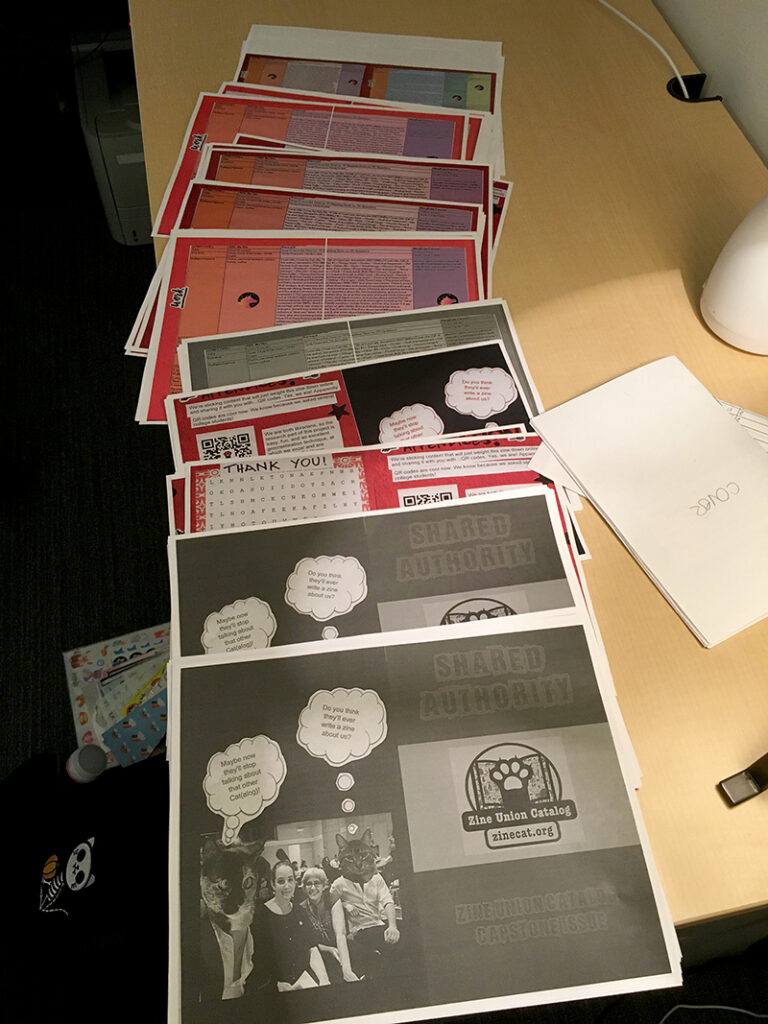
It took this many attempts to print the sucker,

photo of ten versions of a zine layour

Categories
capstone

T Minus 4 Days Until Capstone Zine Submission

A meme of an orange tabby cat resting face on a concrete fence with the caption: Can't You See I'm Busy?

The last few weeks have been very productive and busy for us!  This last weekend was no different. We are getting ever closer to revealing the updated zinecat.org interface which will have more, more, more records.  31k+ records. That should be released by the end of the week, hopefully. There have been some additional ingest hiccups involving version control of ingest MAPs, dates continue to be a thorn, and it turns out that multiple fields of a data set pointing to the same field within Collective Access doesn’t turn out well (i.e. if there are multiple columns of data with “notes” — MARC 500 = Notes and 520 = Summary fields — all pointing to the CA field ca_objects.general_notes).  Eric from OpenFlows has been tremendously helpful in providing support to us in this process and along with Jenna has done some impressive troubleshooting. The solution to the last hiccup listed above was to add another field in Collective Access so that both data points can successfully transfer into the system. Now, we just have to figure out why some of the Subject Headings are showing up as numbers!   

Categories
class projects

Lauren’s ZineCat Independent Study

Just in time for the holidays, I am gifting everyone the final draft of my independent study report. It took me three semesters to complete, but it sure was fun. 🙂

A great big THANK YOU to Maura Smale who has been a great adviser and friend through the process of writing this.

Categories
updates

Just Add ZineCats

This weekend our focus was the public interface, which was pretty much nonexistent on our development platform. Also, as it turns out, the live zinecat is a little dead. 

A screenshot of an internet browser reads, "This page isn't working / browse.zinecat.org is currently unable to handle this request. / HTTP ERROR 500"

Categories
capstone

ZineCat White Paper update

A simple black and white drawing of a rectangular page folded in half, showing how to fold a paper to create a 4 page zine.

Dear Maura & Lisa (as well as anyone else reading this):

We would like to update you on our progress as we are about a month away from the date of submission for the capstone project.  We have ingested 31,919 records from six collections into the development site and will be working on finalizing the front end of ZineCat Dev Site so that it can be viewed by the public next weekend.  For now, take our word that you can discover a much greater sample of zine records! We had planned to include Anchor Archive (or at least their subject thesaurus) and reached out to a colleague that had shown interest in submitting zine records to us about a year ago (but we weren’t ready then to receive the additional collection), but neither of those prospects have come to fruition.  As has been noted in many updates over the last two+ months, Collective Access has provided its fair share of technical challenges. It’s not a perfect system, but let’s be honest, what is? We will be including a section in our white paper zine for software reviews and will be sure to cover all the imperfect technology we’ve encountered along the way!

Categories
capstone updates

Ingestion

We’re back to ingesting records, as we finally got a good extract from QZAP, thanks to zine librarian Dianne Laguerta, who worked with the data as part of a Code School program. And the records are still giving us/CollectiveAccess indigestion. 

A photo of a 1980s woman with a bloated middle, with a purple wash over it for some reason.
Another dated reference, this image is from a 1980s Pepto Bismol commercial https://www.youtube.com/watch?v=BK0o1HJGVrw

Categories
capstone

Bibliography

A baby bib that reads "I [heart] Bibliographies."
From Bibliography Baby Bibs shop on Cafe Press
We’re making a zine for our final project because that’s how we are, and we don’t want to weigh it down with an extensive bibliography. We’re posting the full bib here, and will link to it in our zine. Enjoy!

css.php