Our Zine Hack/Doc day has come and gone and it was quite the day! Fifteen participants spent the better part of Sunday, October 6, 2019 embarking on a discovery of the Zine Union Catalog. This entailed conversations about user needs, metadata, shared authority, cataloging challenges, workflows, algorithms, and human interventions in any ZineCat workflow. Participants had a varying degree of familiarity with ZineCat and/or with Collective Access, the platform that ZineCat is run on, and came from a variety of institutions (including a co-developer of CA!). We also had one attendee join in from Milwaukee using Zoom and we thank them for tolerating the intermittent wifi disconnection and sometimes poor sound quality. Ultimately, it turned out to be more discovery than hack/doc, but we’re happy with the way it turned out! The following is a summary of the day’s events.
Category: updates
Lauren and I have agreed to post alternating updates on our progress as we collaborate on our capstone project: ZineCat improvements, planning and documentation. Our goals, as recorded in our prospectuses are:
- extend the existing prototype with larger record sets and additional metadata fields (wild descriptors and uniform date and location)
- project management via one, unified GitHub repository (instead of this one, this one, and this one)

Categories
“Draw ZineCat without using words”

I was tasked with this challenge earlier this week in the first day of the CUNY Graduate Center’s Digital Research Institute! We were given a large sheet of paper and coloring utensils and told to draw our research!!
I drew a blank (hehe) and panicked, but after 120 seconds of panicking, I was inspired. Start with the cat (for CATalog)! I drew a little cat on the cover of a zine. Then I drew some other clustered rectangles representing the zine collections that will be included in ZineCat with all clusters pointing to the Catalog. And voila! My drawing. With no words.
I’d like to thank Lisa Rhody for a lot of things, but especially for kicking off the GCDRI in this way. It’s refreshing to start a tech conference with paper and colored pencils. I also met a digital fellow whose research includes a zine collection. Connections!
There’s also been a healthy dose of learning about technology tools that can be used in the Digital Humanities, the Academy, the professional world, and more specifically, for ZineCat. I’ll write a longer post about this in the near future, but for now, know that I’ve been busy learning how to use the command line to execute version control over files and projects, how to push this content to GitHub, how to program using Python, and today we’ve done quite a bit of Text Analysis using python and Jupyter Notebook. It’s been a lot and I’m quite tired, but well worth the exhaustion.
More soon…
My working title is Cataloger as Author, Metadata as Annotation, but based on the outline I just turned in, I’m not sure if the title will remain. I welcome feedback, using hypothes.is or, if you prefer, via the Google Docs comments function. If you wish to share via the latter, please send a Google account address to me at leslzine at gmail.

Lauren and Jenna met up with collaborators at the Zine Librarians UnConference, where we facilitated three Zine Union Catalog sessions (with links to session notes)
Categories
Data Visualizations!
Lauren and Jenna completed their Visualization and Design: Fundamentals summer class. They both used zine metadata for their final projects.
Lauren’s focused on keywords from the Queer Zine Archive Project and Jenna’s was about genre terms at the Barnard Zine Library.
Here’s a taste of Lauren’s
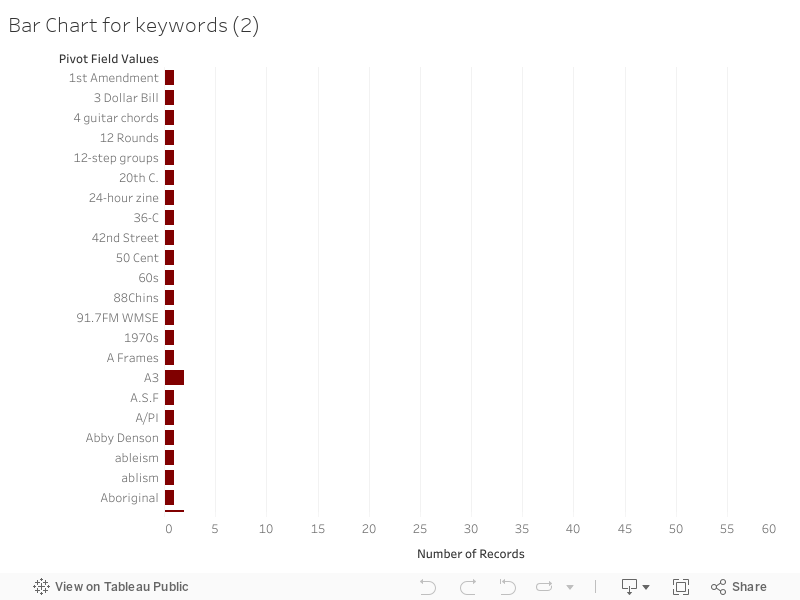

And a morsel of Jenna’s

Lauren’s project on Github pages. Lauren’s white paper is included on her Github.
Jenna’s project on Github pages. Jenna’s white paper is available via pdf.
Let us know what you think!
Categories
Final Project Presentation
Dear You,
Tomorrow we are presenting our final project. After that we’ll have ten days to finish up our final paper.
Our final paper assignment, reflected in our final presentation was to write 12-15 pages with elements including
- Abstract with a clear problem statement
- Project narrative
- Environmental scan
- Work plan
- Strategy for our independent
We’re at 34 pages right now, but maybe since there are two of us…
Then again, since there are two of us, we were also charged with planning workshops for the Zine Librarians unConference in July, which we did: Overview, Priorities, Hack. Librarian overachievers, party of two!

If appropriate, we’ll share the final paper with y’all when we turn it in. It’s due May 24. It’s too dogdamn long, so maybe we’ll do you a favor and make an executive summary.
Dear You,
 Yesterday we had a conference call with other folks working on the Zine Union Catalog. (Thanks Rhonda/MIT for hosting using a proprietary web conferencing tool that shall remain nameless; thanks Milo for facilitating; thanks Honor for taking notes! Thanks also to Jennifer, Eric, and Ziba (while on reference!) for participating, along with us: your CUNY masters students Lauren and Jenna.)
Here are the meeting minutes, tidied up a little, and anonymized:

The problem ZUC will address:
One sentence version
Zine readers, researchers, and librarians need a unified resource for finding finding and sharing zine metadata and location information.
Expanded
For the same reasons readers, scholars, and information professionals benefit from resources like WorldCat and DPLA (Digital Public Library of America), people concerned with zines would be well-served by a union catalog for zines. ZineCat will aid academic and independent readers who want to find information about individual zines, as well as about the breadth of zine resources available on particular topics. A ZineCat user could type < cutting > into a search and find zines that reference cutting/self-injury in libraries all over the world. As WorldCat does, at a later point in its development, ZineCat will facilitate loans between zine libraries, even beyond the scope of WorldCat because ZineCat will include among its members the types of independent libraries that are not typically OCLC members, libraries without budgets, paid staff, or formal status.
ZineCat will offer a similar benefit to zine librarians, allowing them to share catalog records, metadata, and knowledge. Further, having developed a Zine Librarians Code of Ethics, the zine library community has proved itself thoughtful, loving, and critical, which bodes well for a carefully built tool informed by deep processing and cooperation.
