Categories
miscellaneous zine librarians

Celebrating International Zine Month

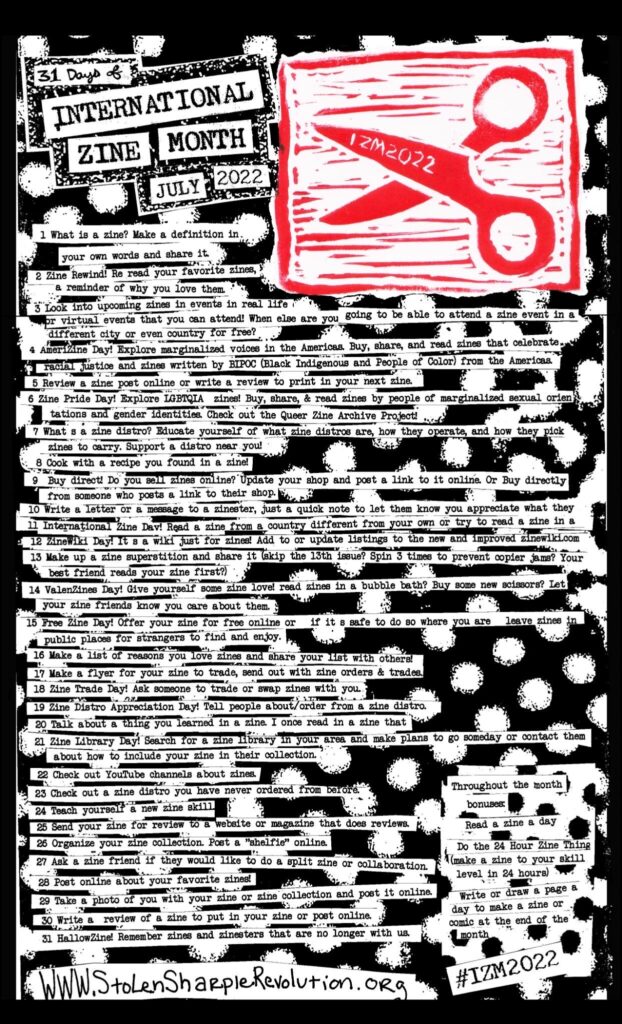
A black and white poster with a pair of red scissors printed on the top right hand corner. The poster suggests 31 prompts for each day of International Zine Month.
Image Credit: Alex Wrekk

July is International Zine Month! Alex Wrekk of the Stolen Sharpie Revolution put together this awesome poster with prompts for each day of the month. The text from the poster is shared below:

31 Days of International Zine Month 2022 #IZM2022

1 – What is a zine? Make a definition in your own words and share it.

2 – Zine Rewind! Re-read your favorite zines and remind yourself why you love them.

3 – Look into upcoming zine events to attend in real life or virtual events that you can attend! When else are you going to be able to attend a zine event in a different city or even country for free?

4 – AmeriZine Day! Explore marginalized voices in the Americas. Buy, share, and read zines about racial justice and zines written by BIPOC (Black Indigenous and People of Color) from the Americas. Need a place to start? Check out Brown Recluse Zine Distro. 

5 – Review a zine: post it online or write a review to print in your next zine.

6 – Zine Pride Day! Explore LGBTQIA+ zines! Buy, share, and read zines by people of marginalized sexual orientations and gender identities. Check out the Queer Zine Archive Project! 

7 – What’s a zine distro? Educate yourself of what zine distros are, how they operate, and how they pick zines to carry. Support a distro near you!

8 – Cook with a recipe you found in a zine!

9  – Buy direct! Do you sell your zines online? Update your shop and post a link to it online so people can get your zines directly from you. Or buy directly from someone who posts a link to their shop.

10 – Write a letter or send a message to a zine maker, just a wuick note to let them know you appreciate what they do.

11 – International Zine Day! Buy, share, or read zines from a country different than your own.

12 – ZineWiki Day! It’s a wiki just for zines! Add to or update listings to the new and improved zinewiki.com

13 – Make up a zine superstition and share it (skip the 13th issue? Spin 3 times to prevent copier jams or avoid paper cuts? Your best friend has to read your zine before anyone else?)

14 – ValenZines Day! Give yourself some zine love in whatever way it means to you! read zines in a bubble bath? Buy some new scissors? Let your zine friends know you care about them.

15 – Free Zine Day! Offer your zine for free online or – if it’s safe to do so where you are – leave zines in public places for strangers to find and enjoy.

16 – Make a list of reasons you love zines and share your list with others!

17 – Make a flyer for your zine to trade with others, post online, or send out with zine orders and trades.

18 – Zine Trade Day! Ask someone to trade or swap zines with you.

19 – Zine Distro Appreciation Day! Tell people about your favorite zine distros! Order zines from a distro.

20 – Talk about something you learned in a zine. Start with “I once read in a zine that…”

21 – Zine Library Day! Search for a zine library in your area and make plans to go someday or contact them about how to include your zine in their collection.

22 – Check out YouTube channels about zines. Here are some to visit:

23 – Check out a zine distro you have never ordered from before.

24 – Teach yourself a new zine skill (like a new binding technique or how to make a 1 page zine).

25 –  Send your zine out for review to a website or magazine that does reviews.

26 – Organize your zine collection. Post a “shelfie” online.

27 – Ask a zine friend if they would like to do a split zine or collaboration with you.

28 – Post online about your favorite zines!

29 – Take a photo of you with your zine or zine collection and post it online.

30 – Write a review of a zine to put in your zine or post online.

31 – HallowZine! Remember zines and zinesters that are no longer with us.

Throughout the month bonuses :

  • Do the 24 Hour Zine Thing (make a zine to your skill level in 24 hours)
  • Read a zine a day.
  • Write or draw a page a day to make a zine or comic at the end of the month.
  • Write a letter or online post about your #IZM2022 experience.
Categories
conference presentations updates zine librarians

Summer Updates

It’s been a busy few weeks with the ALA (American Library Association) Conference and Zine Pavilion last month. At the conference, Lauren gave a presentation on the Zine Union Catalog and garnered a lot of interest in the project as well as questions around metadata. For this occasion, we also produced new issue of Shared Authority. Volume 2.5 (along with all our previous issues) can be found on our public Google Drive.

This summer, we are also prioritizing accessibility. ZineCat is currently doing a web audit with HaiDev (with many thanks to Eric, who is project managing this) with the goal of making improvements to our site. We have also been producing other formats for our zines (audible and plain text), which can also be accessed on the public Google Drive. All three issues of Shared Authority are available as scanned pdfs, as well as in audible and plain text files.

If you have any other suggestions on improvements we can implement to make ZineCat more accessible to all, please let us know. Feel free to send us an email at zinecatproject AT gmail.com. We always appreciate your feedback.

The back and cover of Shared Authority v. 2.5, which features the ZineCat paw logo on the cover and an photo of an orange cat lounging next to a previous issue of Shared Authority on the back. Inscribed are also the names of the ZineCat Team: Lauren Kehoe, Jenna Freedman, Eric Goldhagen Freedman, Vita Kurland, and Jennifer Chen-su Huang.
Back/Cover of the lasted issue, Shared Authority v. 2.5

Categories
conference presentations miscellaneous updates zine librarians

Zines & Libraries Conference 2022

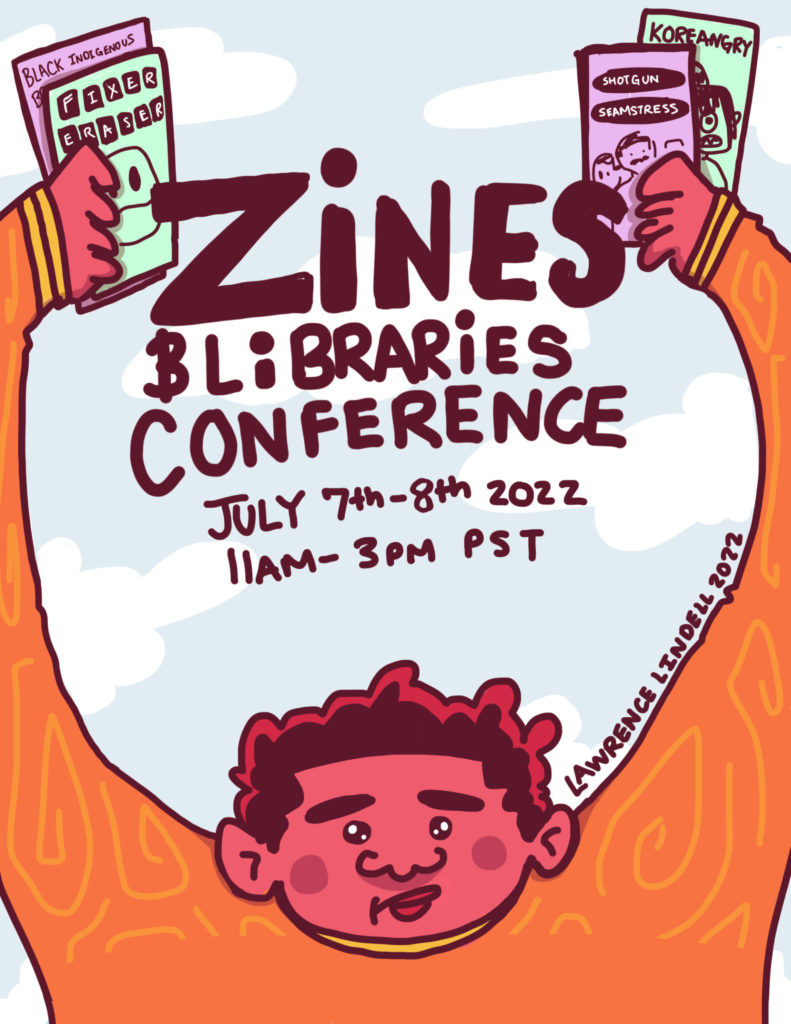
Playful drawing by Lawrence Lindell of a person in orange holding up zines with details concerning the conference written in the space between the person’s raised arms.

Happy International Zine Month! Join us for the 2022 Zines & Libraries Conference that starts tomorrow. Our very own Jenna Freedman will be speaking on Friday at 11am PST.

What: The Zines & Libraries Conference is a two-day virtual conference that will gather together librarians, zine artists and educators to learn about all things zines! Presenters will go over zine history, cataloging, starting a collection as well as provide tools, resources and tips on how to successfully integrate zines into libraries and instruction.

Who: Anyone interested in zines, libraries, zine librarianship and organizing zine events!

Where: This is a virtual conference, with nine separate virtual sessions, each 50 minutes long. All sessions will be hosted virtually through Zoom. Closed captioning will be provided. Please register down below.

When: July 7th-8th, 2022 (Thursday and Friday), 11am-3pm PST

How to register for the conference:

Here is the link to register for sessions: 2022 Zines & Libraries Registration

Many Thanks!

This conference is made possible through the John F. Helmer Professional Development Grant through the Orbis Cascade Alliance consortium and organized by librarians Maria Cunningham (Oregon Health and Science University) and Ann “A’misa” Matsushima Chiu (Reed College).

Please email questions about registration or accommodations to Elizabeth Duell eduell@orbiscascade.org

Categories
miscellaneous updates zine librarians

Highlights from NYCDH Week

There is a logo of NYCDH Week with a New York cityscape in black behind the letters. On the bottom is a chart featuring the frequency of certain words represented, like “coronavirus” and “black." Below, there is an image of multi-colored words in different orientations. Some words are larger than others. Here, the word “women” in blue is largest.

Text Analysis with a Zine Corpus- NYCDH Week 2/10/22

by Vita Kurland

In February I had the pleasure of attending the Text Analysis with a Zine Corpus workshop hosted by by Filipa Calado (CUNY GC Ph.D student), Jenna Freedman (Barnard Zine Library curator), and Miranda Johnson (University of Wisconsin-Madison, MLIS student) for NYCDH week. Utilizing seventeen zines from the digitized collections at the Barnard Zine Library, the project seeks to make zines available for text analysis, solidifying their place in Digital Humanities scholarship. 

The workshop was both an introduction to the process of building the corpus as well as an introduction to Voyant-Tools, the software used for the textual analysis. The presenters discussed the significance of zines and engaged participants in the ethics and steps of creating a corpus highlighting the works of zine creators from minoritized identities. In creating the catalog, the team experienced challenges with transcription and discussed the responsibility of communication around consent to digitize the selected texts. Using Voyant-Tools and a pre-written Python script, the presenter’s discussed the possibilities of text analysis and visualization as a means to revolutionize zine scholarship pushing the boundaries of exploration beyond the physical object. 

So what is a zine corpus? A corpus is a collection or body of texts, in this case of zines from Barnard College’s Zine Library. Developing the corpus Calado, Freedman, and Johnson chose from a range of genres, and author identities to select a representative example of the zine catalog. The Barnard Zine Library collects zines on feminism and femme identity by people of all genders with an emphasis on zines by women of color. Once the body of texts was selected they were transcribed with a combination of manual labor and an OCR  converter or “Optical Character Recognition,” a technology that recognizes text within scanned documents and images. 

What knowledge is gained using text analysis and visualization? Text analysis is a tool used in Digital Humanities scholarship as a means for scholars to read bodies of text in new ways by using machine learning to pick up on word frequency patterns in texts. Text analysis, often referred to as “distant reading” or “topic modeling,” provides new insight into textual patterns and features such as word frequency and approximate words.  In contrast to close readings of texts, the use of computational tools enhances the study of texts in ways that an individual might not notice or even be capable of. For example how many times the word “feminist” might appear in a text and what the surrounding words. 

Voyant-Tools software was used as part of the presentation to explore the zine corpus. Voyant is an open-source browser-based interface that analyzes any imported text. It allows users to upload a corpora and visualize patterns in various ways. For example, users can experiment with colorful word clusters, or  “word clouds” that represent word frequency and visualize how specific words and phrases appear across texts in line graphs.

The questions posed by the workshop were: what new areas of research can be identified through this type of work and what is gained or  lost when stepping away from the physical object (close reading)?  These questions are important because zines are such ephemeral objects – so much is gained from experiencing zines physically. While information might be lost from not having the experience with the physical object, access to the zines as sources for information is greatly increased. As someone with minimal Digital Humanities experience I was excited to hear about this project because it bridges my understanding of zines as ephemeral DIY publications with the world of computational tools and data analysis. While I don’t have answers to these questions it was apparent when using Voyant-Tools to explore the corpus that there is much to be explored. 

This project invites zine enthusiasts to explore the possibilities of text analysis and carves a space for zines in the larger sphere of the Digital Humanities and distant reading. We at ZineCat are excited to see how this project evolves and what insights can be gleaned from the textual analysis of zines. 

Categories
miscellaneous zine librarians

Contribute to List of Zine Collections

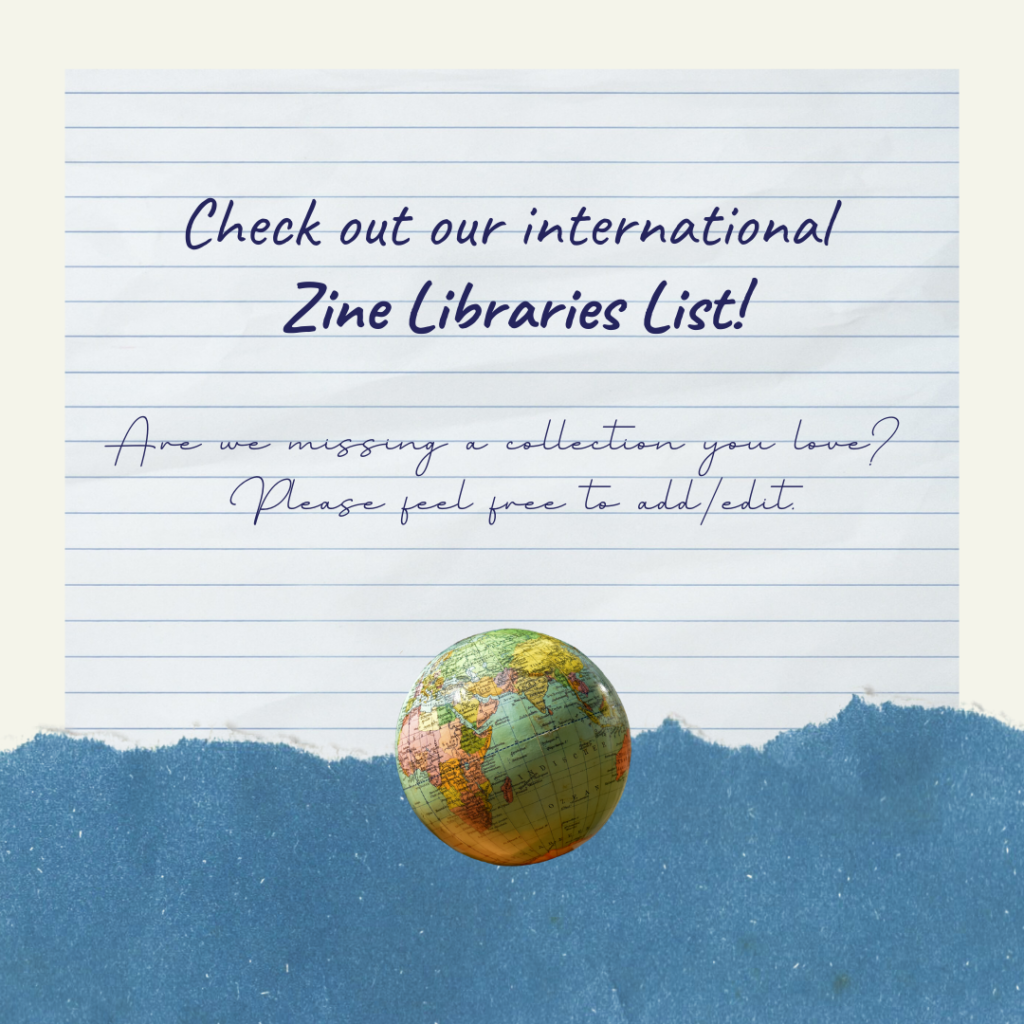
We have assembled a very long list of zine libraries, collections, and archives from around the world. Check out our shared list to learn about a vast array of zine holdings and to make sure that we did not miss your favorite collection. Feel free to leave a suggestion directly on the document. ZineCat deeply appreciates your contributions!

Collaged image of lined paper and blue paper on the bottom and a small globe on top. On the lined paper writes: “Check out our international Zine Libraries List! Are we missing a collection you love? Please feel free to add/edit.”
Calling all zine librarians/lovers – please let us know of your favorite zine archives, collections, and libraries!
Categories
updates zine librarians

Zine Librarians unConference 2018

Lauren and Jenna met up with collaborators at the Zine Librarians UnConference, where we facilitated three Zine Union Catalog sessions (with links to session notes)

Categories
updates zine librarians

Of Caticorn Herders and Glarings

Dear You,

A drawing of a unicorn cat face in red marker on white board.Yesterday we had a conference call with other folks working on the Zine Union Catalog. (Thanks Rhonda/MIT for hosting using a proprietary web conferencing tool that shall remain nameless; thanks Milo for facilitating; thanks Honor for taking notes! Thanks also to Jennifer, Eric, and Ziba (while on reference!) for participating, along with us: your CUNY masters students Lauren and Jenna.)

Here are the meeting minutes, tidied up a little, and anonymized:

css.php